
Delivering Measurable Impact Across Industries
A selection of engagements spanning Business Intelligence, Automation, and AI — each aligned to unlocking revenue, efficiency, and competitive advantage for our clients.
Business Intelligence
Situation
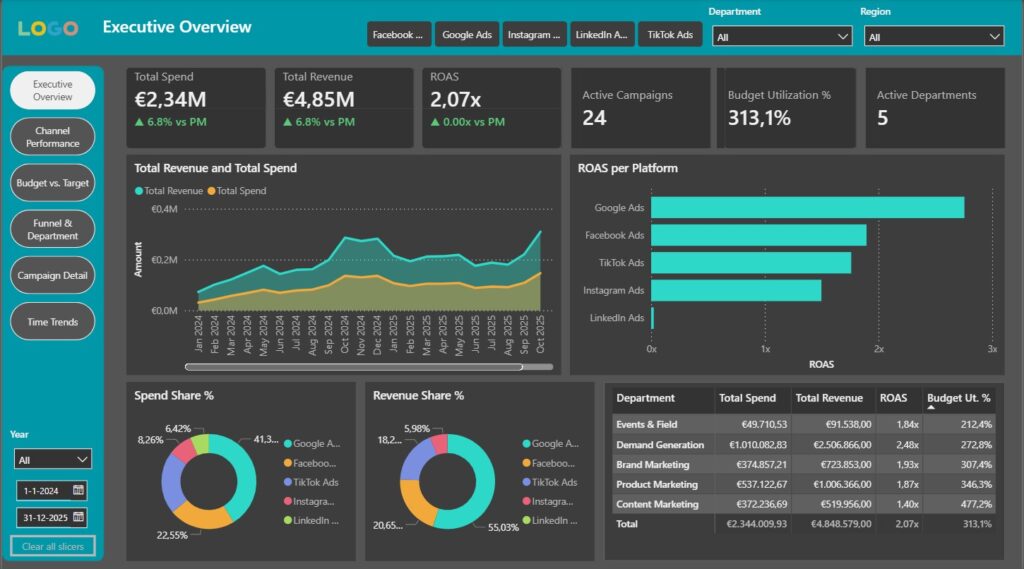
A mid-sized e-commerce company was running paid campaigns across Google Ads, Facebook, Instagram, and LinkedIn but had no unified view of performance. The marketing manager relied on manually compiling platform exports into spreadsheets — a time-consuming process delivering outdated insights. Budget pacing was reactive, channel ROI unclear, and leadership lacked confidence in spend decisions.
What was done
Designed and delivered a 6-page interactive Power BI Marketing Dashboard with 69 pre-built DAX measures covering core metrics, budget tracking, goal variance, and cross-channel benchmarking. Features include executive KPI summaries with MoM trends, CPC vs. CPA quadrant analysis, pro-rated budget burn-down, traffic-light formatting for ROAS/CPA thresholds, and a campaign efficiency matrix identifying top performers and money pits.
Results
- Reduced monthly marketing reporting effort from 2 days to 15 minutes
- Identified underperforming channels, enabling 20% reallocation of ad spend toward higher-ROAS platforms
- Delivered real-time budget pacing visibility, eliminating end-of-month overspend by 30%

Situation
A growing SME lacked a consolidated financial overview. The finance manager tracked revenue, margins, and cashflow in separate spreadsheets — making it difficult to spot profitability trends, monitor budget compliance, or anticipate cashflow bottlenecks before they became critical.
What was done
Designed and delivered an interactive Power BI Financial Dashboard covering P&L analysis, balance sheet monitoring, and cashflow forecasting in one integrated solution. Key features include waterfall charts bridging gross revenue to EBITDA, product/service scatter analysis (revenue vs. margin), an 8-week cashflow forecast with AP ageing buckets, cash conversion cycle tracking, and automated budget variance alerts with traffic-light formatting across MTD, QTD, and YTD periods.
Results
- Reduced month-end financial reporting from 3 days to under 1 hour
- Identified cashflow bottlenecks 6 weeks ahead, improving working capital efficiency by 18%
- Enabled profitability decisions per business unit, resulting in 12% margin improvement on underperforming segments

Situation
An SME struggled with limited visibility over stock levels, leading to frequent stockouts on fast-moving products while excess inventory tied up working capital in slow-movers. Reorder decisions were reactive and based on gut feeling rather than data, and there was no structured way to identify dead stock or evaluate supplier performance.
What was done
Designed and delivered an interactive Power BI Inventory Dashboard providing real-time insight into stock levels, product performance, and actionable replenishment interventions. Key features include GMROI benchmarking against targets, weeks-of-stock calculations based on rolling 13-week sales, scatter analysis plotting gross margin against inventory turnover, automated reorder recommendations per SKU, and dead stock identification with value quantification. Drill-through functionality enables direct navigation from inventory buckets to product-level detail.
Results
- Reduced stockouts by 35% through proactive, data-driven replenishment recommendations
- Identified and cleared dead stock worth 12% of total inventory value, freeing up working capital
- Improved overall inventory turnover by 20%, strengthening cashflow and supplier negotiation position
.
Situation
An infrastructure planning client needed to demonstrate and quantify social value outcomes to public sector stakeholders, funding bodies, and planning authorities. Data was dispersed across multiple systems with no unified view, making it impossible to present a coherent, evidence-based narrative with any speed or consistency. Reporting was manual, time-consuming, and failed to reflect the true community impact of projects in progress. The organisation risked losing stakeholder confidence and delaying planning approvals due to its inability to communicate impact with clarity and rigour at the pace decision-makers required.
What was done
Designed and implemented AI/ML tools using NLP, geospatial analytics, and predictive scoring resulting in a social value impact dashboard. The solution translated raw project data into meaningful social metrics — employment creation, community investment, environmental footprint — and presented them in visual formats tailored for both executive and government audiences. Multi-source data integration with automated refresh pipelines was implemented alongside AI-assisted pattern recognition to surface emerging social value trends, custom reporting layers aligned to public sector assessment frameworks, and scenario modelling capability to project future community impact.
Results
The ability to demonstrate measurable community benefit with speed and rigour directly strengthened stakeholder trust and accelerated approval processes.
- Improved stakeholder reporting efficiency
- Secured and accelerated planning approvals
- Quantified community ROI
Situation
A B2B organisation with a distributed field sales force faced escalating operational costs driven primarily by excessive manual data entry. Sales managers had poor visibility into pipeline health, conversion rates, and individual performance, forcing decisions based on intuition rather than evidence. The absence of a unified platform meant duplicated effort across teams, unreliable forecasting, and a structural inability to identify where revenue opportunities were being lost — limiting both accountability and growth potential across the business.
What was done
Led the end-to-end solicitation of business and market requirements, translating stakeholder needs into a comprehensive salesforce management platform with embedded BI capabilities. The platform streamlined data capture at the point of activity, eliminating redundant entry and feeding real-time performance dashboards for management at every organisational level. Deliverables included requirements workshops across sales, operations, and finance; field-optimised mobile data capture; real-time pipeline and conversion dashboards; automated performance alerts and team-level benchmarking; integration with CRM and financial reporting systems; and role-based dashboard views from field rep to board level.
Results
The platform delivered immediate and measurable operational savings while simultaneously unlocking a material revenue uplift. Field teams spent less time on administration and more time selling, while management gained the visibility needed to coach teams with confidence and forecast with accuracy.
- Reduced 75% data entry costs
- Generated 25% revenue growth
- Duplicated reporting eliminated
Automation
Eliminating manual friction and enabling scalable operations through intelligent workflow and process automation..
Situation
A mobile operator sought to diversify its B2B revenue by developing a commercially differentiated proposition targeting enterprise clients across logistics, field services, retail, and utilities. Existing enterprise offerings were commoditised, generating insufficient margin and failing to create meaningful client stickiness or competitive separation from rival operators. The business needed a strategy grounded in genuine customer and user insight combined with ICT innovation – one that could be structured as a consortium commercial model and deployed effectively across multiple industry verticals with diverse and demanding operational requirements.
What was done
Crafted a comprehensive mobile workforce enablement strategy combining deep customer and user research with ICT innovation to position automated field solutions as a high-value, differentiated B2B offering. The strategy encompassed product design, partner ecosystem development, commercial modelling, and industry-specific value propositions built around intelligent automation of field team operations. Key workstreams included customer insight research across enterprise segments, an ICT innovation roadmap aligned to real workforce automation pain points, consortium commercial model design, and automated scheduling, reporting, and compliance workflows tailored for field teams across sectors..
Results
The programme created a scalable, repeatable revenue model that continued to grow beyond the initial engagement, establishing the operator as a credible specialist in enterprise workforce technology rather than a commoditised connectivity provider.
- £44.2M consortium revenue
- 890% ROI
- Scalable partner ecosystem
Situation
Pharmaceutical sponsors and clinical research organisations were experiencing chronic patient drop-off and poor medication adherence across trials, jeopardising the statistical validity of study outcomes and placing significant sponsor investment at risk. Compliance tracking was largely manual, reactive, and reliant on coordinator intervention – a model that could not scale across multi-site, multi-country studies. The cost of non-compliance extended beyond individual trials: poor adherence data forced costly protocol amendments, delayed regulatory submissions, and in severe cases produced inconclusive results that required entire studies to be repeated at enormous cost and time penalty to the sponsor..
What was done
Deployed automated compliance tracking and patient engagement tools embedded within a purpose-built healthcare SaaS platform. The solution automated the end-to-end patient touchpoint journey – from enrolment through to study close – replacing manual coordinator follow-up with intelligent, rules-based workflows that identified at-risk participants and escalated exceptions before drop-off occurred rather than after the fact. Capabilities included automated multi-channel reminder and engagement workflows, real-time compliance dashboards for coordinators and sponsors, early-warning risk-flagging logic, protocol-specific configuration for diverse study designs, and audit-ready compliance logs structured for regulatory submissions.
Results
Sponsors received cleaner adherence data, more robust regulatory packages, and material reductions in the cost and timeline risk associated with poor patient retention — with the 45% adherence uplift delivering direct, measurable value to trial outcomes and sponsor confidence.
- Improved study compliance and patient adherence by 45%
- Reduced intervention costs by 25%.
- 1500%+ ROI
- Scalable across multi-site studies
Situation
Healthcare and pharmaceutical clients faced a persistent and costly dual challenge: patients failing to initiate prescribed therapies at all, and patients who did start treatment abandoning their medication regimens prematurely. Both failure modes carried significant clinical and commercial consequences – from poorer patient outcomes to wasted formulary spend and weakened real-world evidence data that undermined product performance narratives with payers and regulators. Existing engagement approaches relied on infrequent, generic communications that failed to adapt to individual patient needs, preferences, or stage within the treatment journey, producing low engagement and no sustained behaviour change
What was done
Designed and launched a fully omnichannel SaaS patient engagement platform automating personalised communications across SMS, in-app messaging, voice, and email — adapting content, tone, and timing dynamically based on each patient’s behaviour, therapy stage, and engagement history. The platform was architected for enterprise scale, enabling pharma and healthcare clients to deploy branded patient programmes rapidly with full analytics, adherence reporting, and regulatory-grade audit trails. Core capabilities included a dynamic personalisation engine, therapy initiation journeys with automated escalation pathways, client-configurable programme templates, real-world evidence reporting dashboards, and end-to-end GDPR-compliant healthcare data architecture.
Results
Industry recognition from a 2024 Healthcare and Pharmaceutical Award confirmed the platform’s position as a category leader.
Artificial Intelligence
Applying machine learning, generative AI, and predictive modelling to create competitive advantage and operational intelligence.
Situation
Organisations across agriculture, energy, logistics, and events – whose operations are materially affected by weather – were relying on generic national forecasts that lacked the spatial and temporal granularity required to drive confident operational decisions. Standard meteorological services provided regional averages too broad to be actionable at site or evel, especially in remote communities in developing countries.
What was done
Built the MyMeteo AI/ML climate forecasting platform, training machine learning models on a combination of historical climate datasets, real-time atmospheric sensor data, and satellite feeds to deliver hyper-local, high-accuracy forecasts at the resolution that operational decision-making actually requires. The platform was designed to serve multiple industry verticals through a configurable API and dashboard layer. Key technical capabilities included ML models trained on multi-source atmospheric data, hyper-local forecasting at site and asset level, configurable alert thresholds tied to client-specific operational triggers, an API-first architecture enabling integration with existing operational tools, and continuous model retraining to improve accuracy over time.
Results
Clients across multiple sectors reported meaningful reductions in weather-related disruption, improved resource planning efficiency, and significantly greater confidence in operational scheduling decisions, especially in the area of farming.
- High-accuracy hyper-local forecasting
- Increased agricultural yields by 30%
Situation
A client with an established Salesforce CRM environment held years of rich customer interaction data but was extracting minimal intelligence from it. Sales teams operated reactively — following up on leads based on gut feel rather than data signals — while managers lacked the predictive visibility needed to forecast with confidence or intervene in deals before they were lost. CRM hygiene was also inconsistent, with manual data entry creating gaps that further undermined reporting quality and pipeline accuracy. The organisation was sitting on a data asset of significant latent value with no mechanism to convert it into competitive advantage or revenue acceleration.
What was done
Integrated a suite of AI capabilities directly within the client’s existing Salesforce environment, ensuring adoption by embedding intelligence into familiar workflows rather than asking users to change their behaviour or switch platforms. The integration delivered predictive lead scoring, automated next-best-action recommendations, natural language data querying for managers and executives, intelligent data enrichment to close CRM hygiene gaps automatically, AI-generated follow-up drafts to accelerate outreach velocity, and pipeline risk flagging with deal health scoring — all surfaced natively within the Salesforce interface.
Results
- Smarter sales prioritisation
- Faster pipeline conversion
Provided decisions on pricing, promotions, client, selection & inventory allocation, providing revenue gains of 7-12% with no increase in costs.
Situation
Pharmaceutical study sponsors were contending with a persistent and expensive problem: patients enrolled in clinical trials frequently missed doses not through intention, but through the ordinary friction of daily life — forgetting, misunderstanding dosing schedules, or disengaging from generic reminder messages that felt impersonal and easy to ignore. The consequences were direct and costly: compromised trial data integrity, inflated sample size requirements to compensate for adherence gaps, and in severe cases, study results that could not meet the statistical thresholds required for regulatory approval — wasting years of development effort and significant capital investment.
What was done
Deployed an AI-powered medication reminder system that moved beyond generic broadcast messaging to deliver personalised, adaptive communications at the individual patient level. The AI engine analysed each patient’s engagement history, response patterns, time-of-day behaviour, and dose schedule to determine the optimal timing, channel, frequency, and message content for each reminder — continuously learning and adjusting throughout the study duration. Capabilities included a behavioural pattern analysis engine predicting and pre-empting missed doses, multi-channel delivery across SMS, app push, and voice, protocol-specific reminder logic configurable by study type, real-time adherence dashboards for coordinators and sponsors, and escalation pathways for persistent non-responders.
Results
The system’s ability to adapt continuously to individual patient behaviour made it significantly more effective than any static reminder approach could achieve at scale.
- Stronger trial data quality, reducing patient recruitment costs by 60%
- Reduced coordinator workload by 25%
Clients Advised
Decades of experience across key global industries:.